Tombs

As I have been sorting out my own journey of grief, I was recently encouraged to revisit the story of Lazarus (Jn. 11:1-44). To be honest, I wasn’t sure how it would help. Afterward I realized...there’s a lot more going on than I originally thought
Knowing the ending
“This illness does not lead to death. It is for the glory of God, so that the Son of God may be glorified through it.” Jn 11:4
From the beginning of the chapter, we can see what Jesus knows. He even tells his disciples, "and for your sake I am glad that I was not there, so that you may believe." But still they don't seem to fully grasp what he is talking about. When they arrive, Martha and Mary say something very similar to Jesus "Lord, if you had been here, my brother would not have died."
It is easy to read the story with full hindsight that the scriptures provide, and wonder what it was that Jesus' followers were not understanding.
And yet, I have to consider how many times have I said similarly in my heart, "Lord, if you had just answered that prayer, this would not have happened."
At least Martha's statement to Jesus is balanced with, "22 But even now I know that whatever you ask from God, God will give you.” and reaffirms her faith that he is the Christ.
I often struggle just to see past my own unanswered prayer without re-submitting to the reality that His plan is best.
In these interactions I think it's fascinating to notice what Jesus is NOT doing. He does not rebuke them with “Oh ye of little faith.” nor does he reprimand them with a “How many times must I tell you?”.
Instead, something more interesting happens. Jesus notices their weeping and “was deeply moved in his spirit and greatly troubled”. He asks to see where Lazarus is laid. And when they show him, what must be the shortest sentence in the Bible occurs in verse 35: “Jesus wept.”
My initial reaction: Why?
Why is he weeping? Jesus knew he was about to perform a miracle and Lazarus would soon be back on his feet. But Jesus stops and mourns with his friends and family.
Even in the midst of their fear and doubt. He meets them where they are at, and weeps as they are weeping. I have to wonder if the Apostle Paul is pointing to Christ's example here when writing “Rejoice with those who rejoice, weep with those who weep” Romans 12:15
Grieve with those who grieve
I will not pretend to understand the entirety of Jesus' grief. But based on his actions in that moment I think we can discern a couple shards of reality:
- Grief is important.
- Jesus knows how to do it properly.
Christ’s pre-existing knowledge of how Lazarus’ story would unfold, didn't lead him to preclude himself from partaking in the process of grief.
This example seems foreign in a culture that encourages us to pack up our feelings and move on from the pain as quickly as possible. Chin up, keep a stiff upper lip, take these pills, be stoic, be strong, stay busy, keep pushing. Christ did none of those things in this moment of loss.
He walked. He stopped. He wept.
Now, I wonder: Is this what Christ does in my life? Is he also deeply moved by my grieving? Does he walk up to the tomb with me as I show him what has been lost?
We can grasp the answers to questions like these from the scriptures:
Take my yoke upon you, and learn from me, for I am gentle and lowly in heart, and you will find rest for your souls. Matt 11:29
"For we do not have a high priest who is unable to sympathize with our weaknesses..." Hebrews 4:15
"He was despised and rejected by men, a man of sorrows and acquainted with grief...Surely he has borne our griefs and carried our sorrows" Isaiah 53:3-4
From scripture, we can see that we have a savior who is intricately aware of the depth of our feelings and emotions. Whether my suffering is self-inflicted, afflicted upon me, or just happenstance. He is well acquainted with it and already carried it on my behalf.
If our closest friends or confidants can meet us in our sorrow, how much more can the author of our personality and psychology empathize with us and bring healing?
Stones in the way
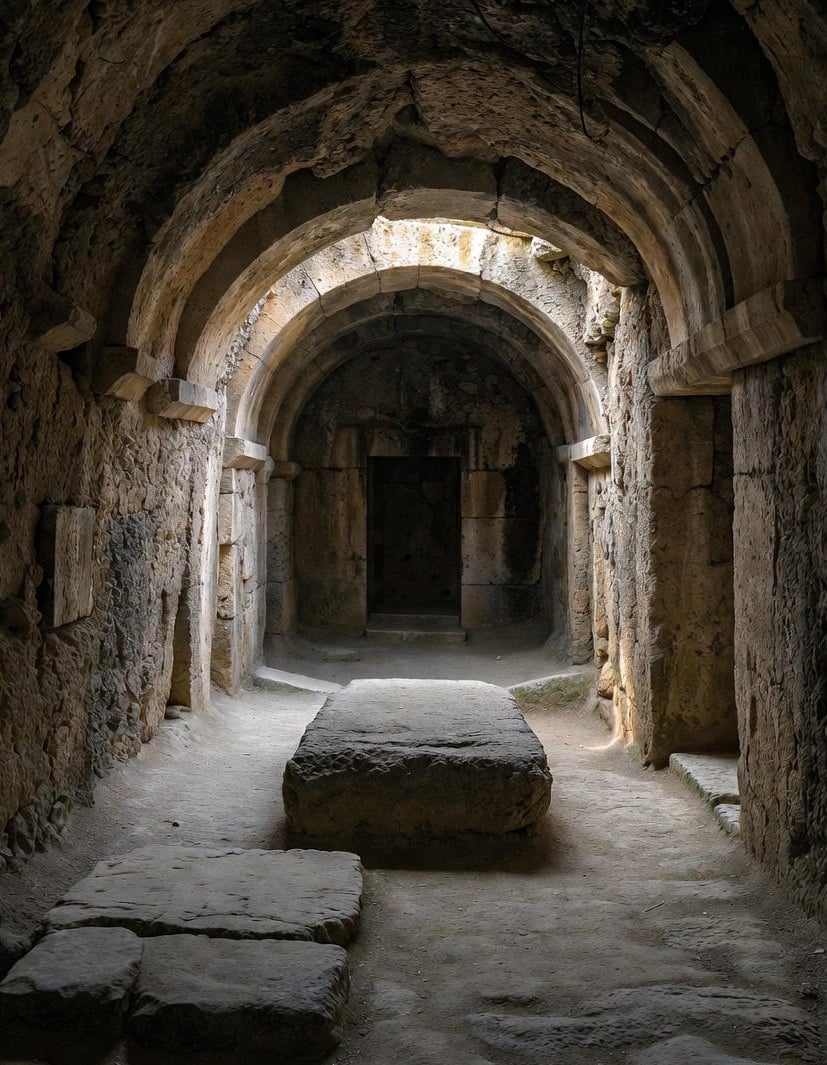
38 Then Jesus, deeply moved again, came to the tomb. It was a cave, and a stone lay against it.
The Apostle John describes witnessing a Jesus that feels deeply and fully embraces the reality of the situation. Knowing the ending does not prevent the process. Only after sufficiently grieving, does Jesus gently direct them into action. In verse 39, Jesus instructs them to roll the stone away. They hesitate, Lazarus has been dead 4 days, there would be a stench. But Jesus reminds them of what he came to do.
39 Jesus said, “Take away the stone.” Martha, the sister of the dead man, said to him, “Lord, by this time there will be an odor, for he has been dead four days.” 40 Jesus said to her, “Did I not tell you that if you believed you would see the glory of God?” 41 So they took away the stone. And Jesus lifted up his eyes and said, “Father, I thank you that you have heard me. 42 I knew that you always hear me, but I said this on account of the people standing around, that they may believe that you sent me.” 43 When he had said these things, he cried out with a loud voice, “Lazarus, come out.” 44 The man who had died came out, his hands and feet bound with linen strips, and his face wrapped with a cloth. Jesus said to them, “Unbind him, and let him go.”
As I imagine witnessing those final verses I am convicted…
What tombs stand in my subconscious mind, deemed too painful to reopen?
What parts of my soul remain sealed off, fearing it has been dormant too long?
What stones need to be taken away in my life so that Jesus can call out to what was once dead?
I believe this is the part where we must have Jesus accompany us to those tombs in our lives. Knowing he leads an example of healthy mourning and that he is faithful to sit with us while we grieve. We can confidently rely on the throne of grace to provide a safe hiding place for us while we grieve in Christ.
Grieve what has been lost to time, circumstance, illness, pain, or death.
Grieve the relationships and memories that lay silently wrapped and buried.
Grieve the parts of ourselves which remain entombed in the catacombs of the mind.
Invited out of the tomb
We know that Christ sees us and is well acquainted with our unique suffering. As you have wept, know that he also wept. Know that the Father has heard your petitions and prayers just as he heard The Son. Then, in faith, we can invite Him to reveal which stones need to be removed.
We can invite Him to call out to those parts of our soul which have been sealed off and declared dead.
We can invite Him to breathe new life and healing into those areas that lie dormant and stale.
We can invite Him to resurrect something out of the pain that brings glory to the Father.
No matter what stage of grief we are in, we must renounce any shortcuts to the process. Of course, any shortcut is not really a shortcut at all. Rather, it's an attempt to quench grief and death in our own power. This method will always fall short and ultimately delay the journey of healing the Lord has mapped for us.
When Jesus called Lazarus out of that tomb, he completed the cycle. He did not tell them to get over it, and he did not skip to the good part. Just as the Israelites were not teleported to the promised land, they had to go through the desert first. In a similar way, Jesus leads the disciples and his family through grief, and through His power, completes the process to rejoicing and revelation.
Grief is an unfortunate but necessary layover as we navigate in a fallen world. Whether or not the full resolution of our circumstance occurs on this side of eternity, I do not know.
The process is difficult, and we should not expect to fully understand it. And yet, because of it, a contrast is formed that allows us to see and bear witness to the Father's resurrecting power accomplished in Christ.
"He will swallow up death forever; and the Lord God will wipe away tears from all faces" Isaiah 25:8
Just as Jesus already knew the joy to occur in Lazarus' story, we can also be confident that grief will not always be a part of ours. We will carry grief in the desert, but there is a promised land in which we can lay that burden down.
As the Apostle John would later record, "He will wipe away every tear from their eyes, and death shall be no more, neither shall there be mourning, nor crying, nor pain anymore, for the former things have passed away" Rev 21:4